







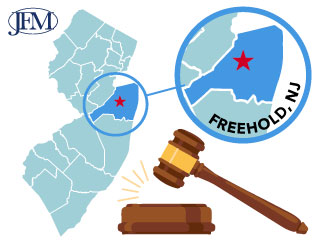
If you were arrested, issued a criminal complaint, or contacted by police in Freehold, where the case is headed matters almost as much as the charge itself. Freehold is home to the Monmouth County Superior Court and the Monmouth County Prosecutor’s Office, so criminal cases arising here can range from local municipal matters to serious indictable prosecutions handled at the county level.
A Monmouth County criminal lawyer with The Law Offices of Jonathan F. Marshall can review the complaint, determine which court and procedural track apply, and begin evaluating the police investigation before important decisions are made about detention, motions, diversion, negotiations, or trial.
Our firm has 20+ attorneys dedicated 100% to defending criminal charges, DWI, and serious motor vehicle offenses, with more than 250 years of combined experience. Our team includes multiple former Monmouth County prosecutors, former high-level prosecutors, former municipal prosecutors, and certified criminal trial lawyers.
Criminal Charges We Defend in Freehold
Freehold cases can begin with a traffic stop, domestic call, citizen complaint, retail investigation, search warrant, drug investigation, or an arrest connected to a larger Monmouth County investigation.
Our attorneys defend Freehold cases involving:
- DWI and serious motor vehicle offenses;
- Drug possession and distribution;
- Aggravated assault and other assault charges;
- Domestic violence and restraining orders;
- Weapons and firearm offenses;
- Theft and shoplifting;
- Harassment and disorderly conduct;
- Resisting arrest and obstruction;
- Sex offenses;
- Juvenile charges; and
- Other disorderly persons and indictable offenses.
The exact charge determines whether the case stays at the municipal level or enters the Monmouth County Superior Court system.
Freehold Is the Center of the Monmouth County Criminal Court System
Freehold is different from many Monmouth County municipalities because the Monmouth County Courthouse is located here.
The Criminal Division of the Monmouth County Superior Court handles indictable offenses prosecuted at the county level. The courthouse is located at 71 Monument Street in Freehold.
The Monmouth County Prosecutor’s Office is also headquartered in Freehold at 132 Jerseyville Avenue.
That means a criminal case originating in Freehold may remain a local municipal matter or quickly become part of the county-level criminal process depending on the charge.
Freehold Borough and Freehold Township Have Separate Municipal Courts
It is also important to distinguish between Freehold Borough and Freehold Township.
Freehold Borough Municipal Court is currently located at 38 Jackson Street in Freehold. The court handles qualifying disorderly persons offenses, petty disorderly persons offenses, DWI cases, traffic matters, and municipal ordinance violations arising within the Borough.
Current information for the Borough court is available through the Freehold Borough Municipal Court.
Freehold Township has a separate municipal court located at One Municipal Plaza. Which local court handles the matter therefore depends on where the alleged offense occurred.
What Happens When a Freehold Charge Is Indictable?
Indictable criminal charges are handled differently from ordinary municipal offenses.
A serious complaint may be forwarded for screening through the Monmouth County Prosecutor’s Office. Depending on the case, the prosecution may involve first appearance proceedings, detention issues, grand jury presentation, arraignment, discovery, pretrial conferences, motions, negotiations, and trial.
The State may also determine during screening that a charge should be handled differently, including potential remand of an appropriate lower-level matter.
Knowing the procedural track early helps determine what evidence should be preserved, which motions may be available, and whether diversion or another resolution should be explored.
The First Days After a Freehold Arrest Matter
The first several days after an arrest or criminal complaint can shape what happens later.
Defense counsel should obtain the complaint and release paperwork, identify the statute charged, preserve available video, locate witnesses, and determine whether statements or searches need to be challenged.
It is also important to keep track of court appearances and release conditions. Missing a required appearance or violating a condition of release can create additional problems that did not exist when the original case began.
If you are concerned that an older Freehold matter may have resulted in a warrant, our guide explaining how to find out if you have a warrant provides additional information.
Pretrial Detention in Monmouth County
New Jersey generally uses a risk-based pretrial release system rather than traditional cash bail.
When a person is arrested on a complaint warrant, Pretrial Services evaluates the case and the court determines whether release conditions are appropriate. Prosecutors may also file a motion seeking continued detention in qualifying cases.
Serious allegations involving violence, firearms, certain repeat offenses, or other public-safety concerns may create particularly significant detention issues.
Defense counsel can present information concerning employment, residence, family responsibilities, criminal history, treatment, proposed release conditions, and weaknesses in the allegations when those considerations support release.
DWI Charges in Freehold
DWI charges arising in Freehold are generally handled through the municipal court serving the location where the alleged offense occurred.
A DWI defense can involve the reason for the traffic stop, field sobriety exercises, body-camera footage, Alcotest procedures, refusal allegations, operation of the vehicle, and police observations.
Our Monmouth County DWI attorneys defend individuals facing drunk driving charges throughout the county.
Learn more about DWI’s in New Jersey here.
Drug Charges in Freehold
Drug cases can begin with traffic stops, vehicle searches, residential warrants, controlled purchases, surveillance, or larger investigations involving the Monmouth County Prosecutor’s Office.
The defense may need to examine whether the accused actually possessed the CDS, whether the search was lawful, whether digital evidence is attributable to the defendant, and whether the alleged quantity supports the degree charged.
Drug offenses can carry serious penalties, making it important to understand how Monmouth County drug possession and distribution charges are handled.
Weapons Charges in Freehold
Firearm cases can create significant sentencing exposure, particularly when New Jersey’s Graves Act applies.
Important issues can include knowing or constructive possession, permits, statutory transportation exemptions, the legality of a search, forensic evidence, and whether prosecutors can connect the accused to the firearm.
Learn more about Monmouth County weapons charges and how firearm and weapon offenses are prosecuted in Freehold.
Assault and Domestic Violence Cases
Assault allegations can remain in municipal court or become indictable Superior Court cases depending on the injury, alleged conduct, weapon involvement, victim, and other circumstances.
More serious assault allegations may result in Monmouth County aggravated assault charges, which can carry significant criminal penalties.
When an incident involves a qualifying domestic relationship, the defendant may also face a separate restraining order proceeding through the Family Division in Freehold. These cases can involve overlapping Monmouth County domestic violence charges and restraining order proceedings.
Searches, Warrants, and Police Evidence
A strong defense starts with how the evidence was obtained.
A Freehold case may involve a vehicle search, residential search warrant, phone extraction, witness identification, body-camera footage, surveillance, laboratory testing, or statements made during police questioning.
Defense counsel can examine whether officers had a lawful basis for the initial encounter, whether a search was supported by consent, probable cause, or a valid warrant, and whether police remained within the lawful scope of the search.
If important evidence was obtained in violation of constitutional protections, the defense can evaluate whether a suppression motion is appropriate.
Building the Timeline of the Case
That means separating what officers personally observed from what witnesses or informants reported, identifying when searches and questioning occurred, documenting when evidence was recovered, and comparing police reports with body-camera footage and other objective evidence.
Once the timeline is organized, inconsistencies can become easier to identify and decisions involving motions, negotiations, and trial preparation can be based on verifiable facts rather than assumptions.
Can a Freehold Case Qualify for Diversion?
Potentially.
For qualifying indictable charges, Pretrial Intervention, commonly known as PTI, may provide an alternative to ordinary prosecution.
Municipal court matters may involve different diversionary options depending on the charge and eligibility requirements.
Prior history, previous diversion participation, offense type, mandatory sentencing provisions, and the circumstances of the allegations can all affect eligibility. First-time offender status alone does not guarantee admission.
Why Our Freehold and Monmouth County Experience Matters
The Law Offices of Jonathan F. Marshall has 20+ attorneys dedicated 100% to criminal charges, DWI, and serious motor vehicle offenses, with more than 250 years of combined experience.
Our team includes multiple former Monmouth County prosecutors, including Tom Huth, former Director of Major Crimes at the Monmouth County Prosecutor’s Office.
Our attorneys also include former municipal prosecutors who served in Holmdel, Wall, Howell, Middletown, Hazlet, Manasquan, and other Monmouth County municipalities, as well as certified criminal trial lawyers.
That background provides firsthand perspective on how Monmouth County investigations may be developed, how serious charges are screened, how evidence is evaluated, and how cases progress from arrest through motions, negotiations, and trial.
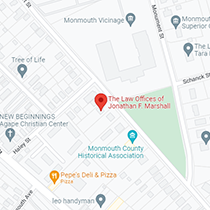
Our Freehold office is also located on Court Street near the Monmouth County Courthouse, placing our attorneys close to the court where indictable Monmouth County criminal cases are handled.
Speak With a Freehold Criminal Defense Lawyer
A Freehold criminal case can move through municipal court, county screening, Superior Court, or a combination of proceedings depending on the allegations. The earlier the procedural track and evidence are understood, the more effectively the defense can prepare.
A Monmouth County criminal lawyer with The Law Offices of Jonathan F. Marshall can review the complaint, police investigation, release conditions, searches, video, witnesses, forensic evidence, and other circumstances before explaining the defense options available.
Contact us online to schedule a free consultation regarding a criminal, DWI, or serious motor vehicle charge in Freehold.
Freehold Criminal Defense FAQs
Where are criminal cases from Freehold heard?
Municipal matters are handled in the municipal court serving the location where the offense occurred. Freehold Borough and Freehold Township have separate municipal courts. Indictable Monmouth County criminal charges are generally handled through the Superior Court Criminal Division in Freehold.
Where is Freehold Borough Municipal Court?
Freehold Borough Municipal Court is currently located at 38 Jackson Street in Freehold.
Where is the Monmouth County Superior Court?
The Monmouth County Courthouse is located at 71 Monument Street in Freehold and houses the Criminal Division responsible for indictable Monmouth County cases.
Can a Freehold municipal charge become a Superior Court case?
Yes. When an indictable offense is charged or the evidence supports a more serious criminal allegation, the case may proceed through the Monmouth County Superior Court system.
Can a first-time defendant qualify for PTI?
Potentially. Eligibility depends on the offense, prior record, previous diversion participation, statutory restrictions, and the facts of the case.
Can evidence be suppressed after an illegal search?
Potentially. A defense attorney can challenge a stop, search, warrant, or seizure when the circumstances support a constitutional claim.
What happens if the prosecutor seeks pretrial detention?
The court holds a hearing and evaluates the allegations, criminal history, public-safety considerations, risk of failing to appear, proposed release conditions, and other relevant information before deciding whether continued detention is warranted.