

Aggravated assault charges are among the most serious violent offenses prosecuted in Essex County. Whether you were arrested after a bar fight in Montclair, a domestic incident in Newark, or an altercation near Rutgers-Newark, you now face a situation where every detail matters. Charges involving bodily injury or the threat of serious harm can carry significant consequences, especially when prosecutors seek to elevate an incident to second- or third-degree aggravated assault.
At The Law Offices of Jonathan F. Marshall, we know how quickly these cases can escalate. What begins as a dispute or self-defense situation can result in more serious charges if police or prosecutors believe a weapon was involved, serious injuries occurred, or another aggravating circumstance applies.
Our team of Essex County aggravated assault defense lawyers evaluates the allegations, evidence, and circumstances surrounding the arrest to determine how the State is attempting to prove the charge. Please don’t hesitate to get in touch for a free case review.
What Counts as Aggravated Assault in Essex County?

Under N.J.S.A. 2C:12-1(b), aggravated assault covers a range of alleged conduct. Depending on the circumstances, prosecutors may focus on the seriousness of an alleged injury, the use of a weapon, the accused person’s intent, or other factors identified by the statute.
The identity or role of the alleged victim can also affect how an assault allegation is charged. Cases involving law enforcement officers, teachers, transit workers, healthcare employees, and others identified by law may be treated differently depending on the circumstances. This can become particularly important in cases arising in municipalities such as Irvington or East Orange.
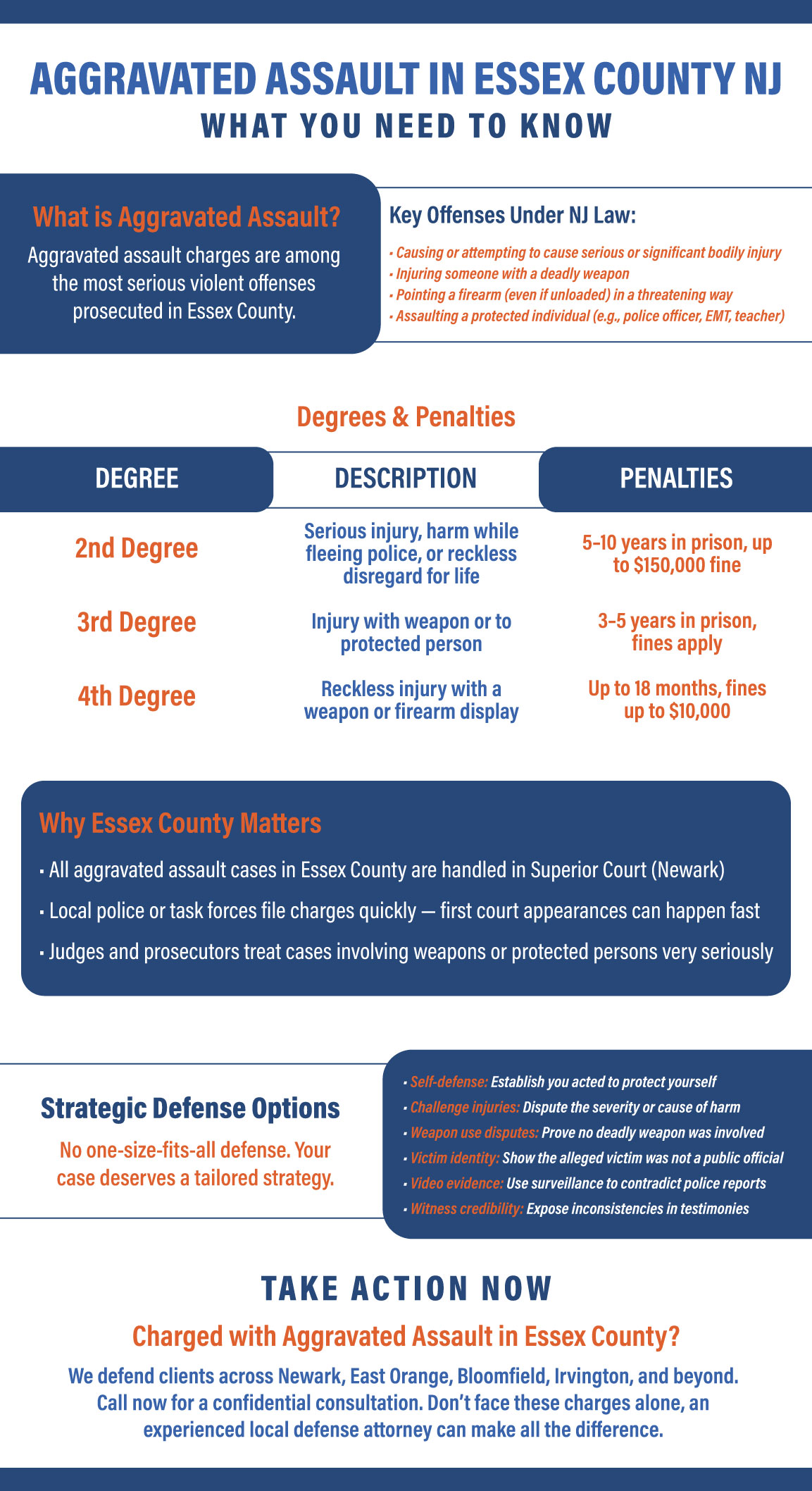
Sentencing exposure varies based on the degree of the offense. A second-degree aggravated assault conviction can result in five to 10 years in prison, while a third-degree conviction carries three to five years. Fourth-degree charges can carry a potential sentence of up to 18 months. Our Essex County criminal defense attorneys evaluate the grading of the charge along with the evidence supporting each required element.
When an Assault Allegation May Be Overcharged
Many people charged with aggravated assault are surprised by how prosecutors characterize an incident. An argument that turned physical, a defensive response during a confrontation, or conflicting versions of the same event can result in allegations that are considerably more serious than the accused expected.
Determining who initiated a confrontation can also become difficult, particularly when alcohol is involved or witnesses provide fragmented or inconsistent accounts. Surveillance footage, 911 recordings, body-camera footage, photographs, medical records, and witness statements may all become important when reconstructing what actually happened.
Our attorneys obtain and compare these materials rather than relying solely on the initial police narrative. As Essex County criminal defense lawyers, we examine whether the evidence actually supports the degree and theory of aggravated assault alleged by prosecutors.
Immediate Action Can Matter in an Aggravated Assault Case
Essex County prosecutors may begin reviewing a serious assault allegation quickly after an arrest. If you were arrested in Newark or Bloomfield, you may soon face an initial court appearance or a detention hearing in Essex County. These early proceedings can address whether you are released, what conditions apply, and whether prosecutors will seek continued pretrial detention.
Early defense involvement also provides an opportunity to identify and preserve evidence before it becomes more difficult to obtain. Surveillance recordings can be overwritten, witness memories can change, and communications or other digital evidence may become harder to recover over time.
Our attorneys begin by examining the complaint, police reports, available recordings, witness accounts, and the circumstances surrounding the arrest. That early review helps determine what issues require immediate attention and what additional evidence should be pursued.
Reviewing How the Charging Decision Was Made
Police and prosecutors make important decisions when determining whether alleged conduct supports simple assault or aggravated assault. The defense should examine the facts behind that decision rather than accepting the initial classification automatically.
That review may include how officers responded to the scene, which witnesses they interviewed, whether conflicting accounts were documented, how injuries were described, whether a weapon was actually involved, and what evidence supports the prosecution’s interpretation of intent.
Mutual combat, self-defense, identification problems, inconsistent witness statements, or incomplete accounts of the confrontation may all affect how the case should be evaluated. Our attorneys work to present evidence and context that may have been missing from the initial police account.
Courtrooms and Law Enforcement in Essex County
Aggravated assault cases charged as indictable offenses are generally prosecuted through Essex County Superior Court in Newark. An investigation may begin with a local police department in communities such as West Orange, Belleville, Maplewood, or another Essex County municipality before the matter proceeds into the county-level criminal system.
The Essex County Prosecutor’s Office handles serious criminal prosecutions in the county. Once a case reaches that level, prosecutors may review police reports, medical evidence, recordings, witness statements, forensic evidence, and other materials when determining how to proceed.
Local police reports, officer narratives, and initial interviews often form an important part of the prosecution’s case. Our attorneys compare those reports against recordings, physical evidence, witness accounts, and timelines to identify inconsistencies or missing context before those initial allegations become the foundation of later proceedings.
We Understand the Prosecutor’s Perspective
One of the advantages of working with The Law Offices of Jonathan F. Marshall is that members of our criminal defense team have prior prosecution experience. Several of our attorneys previously served as prosecutors in Essex County and elsewhere in New Jersey.
That background provides insight into how prosecutors evaluate evidence, charging decisions, witness credibility, negotiations, and trial strategy. Our role is to use that experience on behalf of the defense by identifying weaknesses in the State’s case and determining which factual or legal issues may influence how the prosecution proceeds.
Strategic Defense Options for Aggravated Assault Charges
An aggravated assault defense should reflect the specific facts of the incident rather than rely on a generic strategy. Depending on the allegations, the defense may focus on self-defense, the seriousness of the alleged injury, identification, intent, whether a weapon was involved, the credibility of witnesses, or whether the State can establish the aggravating circumstance it relies upon.
When surveillance footage contradicts a police narrative or witness statement, that evidence may become central to the defense. When witnesses provide inconsistent versions of events, those differences should be documented and examined carefully.
Searches, statements, medical records, body-camera recordings, photographs, digital communications, and forensic evidence may also raise separate issues depending on the circumstances of the case.
Some cases may involve Pretrial Intervention (PTI) or another potential resolution, depending on eligibility and the circumstances. Other matters may involve negotiations concerning the grading of the charge, while disputed cases may require preparation for hearings or trial.
Our Essex County Criminal Defense Lawyers Are Here When You Need Us
You should not have to wait until a court date to begin understanding what you are facing. Early communication with defense counsel can help clarify the charge, the process ahead, the evidence prosecutors may rely upon, and the issues that deserve immediate attention.
Our team provides clients with realistic assessments and ongoing communication as the case progresses. From the beginning of the representation, we work to understand the evidence, identify defense issues, and prepare for the procedural stages ahead.
Please schedule your free case evaluation with an Essex County criminal defense attorney at The Law Offices of Jonathan F. Marshall to discuss your situation.
Frequently Asked Questions About Aggravated Assault in Essex County
Can I be charged with aggravated assault even if I did not use a weapon?
Yes. An aggravated assault allegation does not necessarily require a weapon. Prosecutors may rely on the alleged injury, intent, identity of the alleged victim, or other circumstances when determining what charge to file.
Will the charges be dismissed if the alleged victim recants their statement?
Not automatically. Prosecutors may continue relying on other evidence, including recordings, medical records, photographs, police observations, or witness statements.
Is aggravated assault considered a felony in New Jersey?
New Jersey generally uses the term “indictable crime” rather than felony. Aggravated assault charges can be prosecuted at different degrees depending on the allegations and circumstances.
Can the alleged victim’s occupation affect an aggravated assault charge?
Potentially. The person’s status or occupation may be relevant under certain provisions of New Jersey’s aggravated assault law. The defense should examine whether the prosecution can establish the specific circumstances required for an enhanced charge.
What happens after an aggravated assault arrest in Essex County?
The next steps depend on the complaint and whether the accused is released or detained. Serious cases may involve an early first appearance or detention proceeding followed by county prosecutor review, discovery, motions, negotiations, and potentially trial.
Does Essex County offer diversion programs for aggravated assault charges?
Possibly. Pretrial Intervention may be available in some cases depending on eligibility, prior history, the charge, and the individual circumstances.