
TL;DR
- Federal investigations can last months or even years, depending on the complexity of the case and the evidence involved.
- Common signs you’re being investigated include target letters, grand jury subpoenas, search warrants, surveillance, frozen assets, or an indictment.
- Most federal crimes have a 5-year statute of limitations, but some offenses have longer deadlines and capital crimes have no time limit.
- Federal agencies like the FBI, IRS, DEA, and ATF often spend significant time gathering documents, interviewing witnesses, and building cases before seeking charges.
- If you believe you are under federal investigation, contacting an experienced federal criminal defense attorney as early as possible can help protect your rights and potentially influence the outcome of the case.
Unfortunately, there is no set time limit for how long the federal government can investigate you. Federal investigations can last months or even years, depending on the complexity of the case and the evidence involved. Still, most federal crimes have a statute of limitations, after which the prosecution can no longer file charges for that offense.
Federal agencies like the FBI, IRS, DEA, and ATF have highly trained and well-resourced professionals who often spend significant time gathering documents, interviewing witnesses, and building cases before bringing charges. If you learn that the federal government is investigating you, you should take prompt action to protect your rights and, potentially, your freedom.
Contact the Law Offices of Jonathan F. Marshall today for your free consultation with a New Jersey federal defense lawyer to discuss your case.

How Does a Federal Investigation Begin?
In most cases, a federal investigation begins after a crime is reported to federal authorities. The crime may be reported by an alleged victim, witness, or state or local law enforcement agency with evidence of a federal crime. In some cases, an investigative agent or analyst within a federal agency, such as the Internal Revenue Service (IRS), encounters evidence of a crime in the course of other duties.
A federal law enforcement agency will pursue an investigation to determine whether a federal offense has been committed and who did it. An agency may conduct a preliminary investigation to assess the validity of the initial report or evidence of a crime. Supervisors will review the results of that inquiry to determine whether a full investigation is warranted.
Sometimes, federal agents can quickly make an arrest. But in many cases, investigators must obtain documents, interview witnesses, conduct surveillance, execute search warrants, and otherwise compile and analyze evidence to determine whether the facts indicate the suspect’s guilt.
Once an investigation has concluded, either the case will be closed with no further action or a U.S. attorney will present investigators’ evidence to a grand jury and ask it to issue a charging document known as an indictment.
How Do You Know If the Feds Are Investigating You?
In many cases, there are signs that a federal government investigation is focused on you. You may learn you are under federal investigation via:
- A target letter, correspondence from the U.S. Attorney’s Office stating you are a target of a federal grand jury investigation
- A grand jury subpoena, a legal order compelling you to testify before the grand jury or deliver certain evidence (e.g., correspondence, corporate records, or photos)
- A search or arrest warrant, served upon you at home or at work
- Indications of surveillance, such as unfamiliar vehicles, people suddenly showing up repeatedly, or evidence that your phone has been tapped
- Frozen or seized assets, which may occur in the late stages of an investigation of financial crimes, such as embezzlement, fraud, or insider trading
- An indictment, a clear notice specifying your charges and the potential penalties
Any of the above may happen to you or someone you are associated with who reports it to you. At that point, you need to contact a defense attorney as soon as possible.
Statutes of Limitations in Federal Criminal Cases
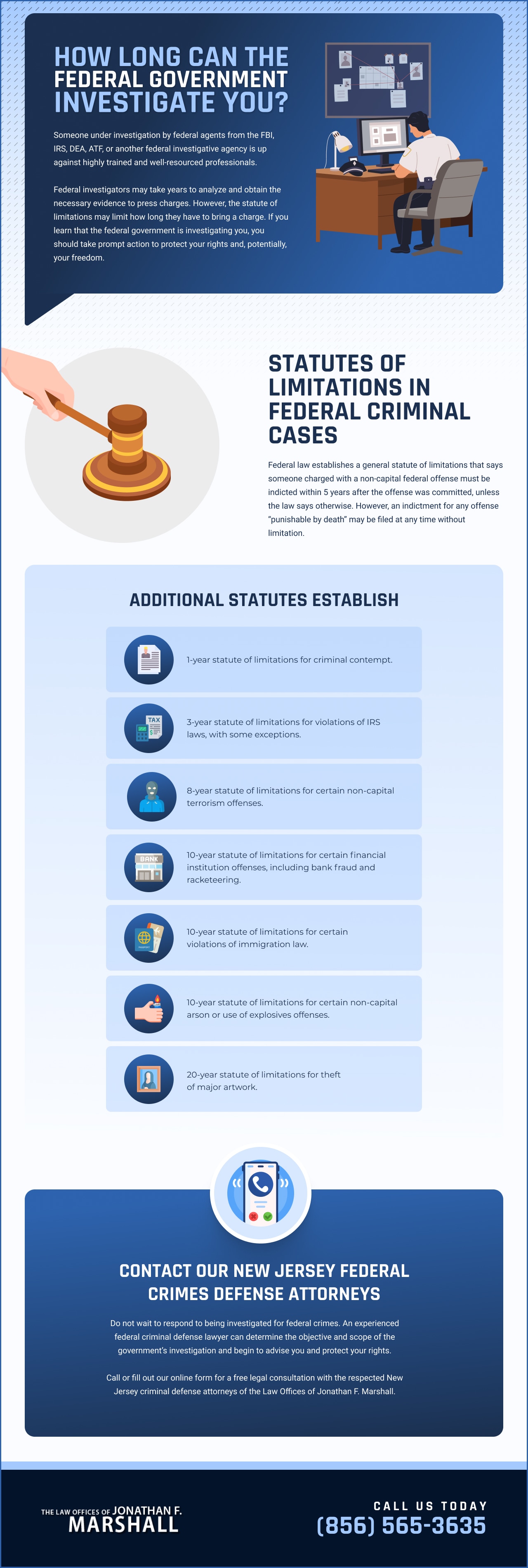
18 U.S.C. § 3282 establishes a general statute of limitations that says someone charged with a non-capital federal offense must be indicted within five years after the offense was committed, unless the law says otherwise. However, an indictment for any offense “punishable by death” may be filed at any time without limitation, according to 18 U.S.C. § 3281.
Additional statutes establish:
- 1-year statute of limitations for criminal contempt (18 U.S.C. § 3285)
- 3-year statute of limitations for violations of IRS laws, with some exceptions (26 U.S.C. § 6531)
- 8-year statute of limitations for certain non-capital terrorism offenses (18 U.S.C. § 3286)
- 10-year statute of limitations for certain financial institution offenses, including bank fraud and racketeering (18 U.S.C. § 3293)
- 10-year statute of limitations for certain violations of immigration law (18 U.S.C. § 3291)
- 10-year statute of limitations for certain non-capital arson or use of explosives offenses (18 U.S.C. § 3295)
- 20-year statute of limitations for theft of major artwork (18 U.S.C. § 3294)
It’s important to understand that the statute of limitations is not the same as the length of the investigation. Still, federal prosecutors will need to complete their investigation and file formal criminal charges before that deadline passes.
How the Federal 5-Year Statute of Limitations Works
The federal statute of limitations imposes a standard five-year period for criminal offenses under federal law that do not have another specific limitations period. Certain criminal offenses, including capital crimes (punishable by death), have no statute of limitations. Under the standard five-year statute of limitations, the government must obtain an indictment or file a criminal information within five years of the alleged offense.
However, the limitations period can begin on different dates for certain offenses, such as conspiracy offenses, for which the clock starts after the last affirmative act committed to accomplish the conspiracy’s goal. Certain crimes also qualify as “continuing” offenses that have no definitive date, such as various possession crimes or failure to register as a sex offender.
Other circumstances can also pause or extend the statute of limitations, such as:
- The suspect or defendant flees from justice (18 U.S.C. § 3290)
- Cases involving child abuse (18 U.S.C. § 3283)
- Cases involving wartime fraud against the U.S. (18 U.S.C. § 3287)
- DNA testing (18 U.S.C. § 3297)
- Efforts to obtain evidence located in foreign countries (18 U.S.C. § 3292)
Factors That Can Extend Investigations
Sometimes, factors in a federal criminal case can extend the investigation. Circumstances that could lead to an ongoing federal investigation include:
- The complexity of the evidence and the offense (e.g., complex financial crimes or crimes involving forensic evidence)
- The number of suspects
- Whether alleged co-conspirators are cooperating with federal investigators and prosecutors
- Parallel investigations, including investigations by multiple federal law enforcement agencies or by federal and state prosecutors
- Delays in recovering evidence from overseas, such as bank or legal records
Grand juries can also prolong federal investigations by issuing subpoenas to obtain witness testimony or documents. If a grand jury does not find probable cause to indict a defendant, federal agents and prosecutors may need to continue investigating to gather more evidence to establish probable cause.
How Does a Federal Investigation End?
A federal criminal investigation may end when:
- Federal agents and prosecutors determine that they have sufficient evidence to charge a suspect with a crime and either file a criminal information or present the case to a grand jury to obtain an indictment.
- A case goes cold and prosecutors determine there isn’t enough evidence to charge a suspect and don’t expect to uncover more.
- Agents or prosecutors learn evidence that exonerates the suspect.
- A perpetrator comes forward to confess their guilt.
A lack of charges does not necessarily signal the end of a federal investigation. Agents and prosecutors may hit a “dead end” but later resume an investigation after receiving evidence that provides new leads. However, for crimes with a statute of limitations, prosecutors may have to drop an investigation once the applicable limitations period expires.
What Can a Federal Criminal Defense Attorney Do to Help You?
You should contact a federal criminal defense attorney at the first hint of a federal investigation or charges against you. Federal criminal cases are often based on complex investigations and involve multiple charges, making it more difficult for the government to prove its allegations. You must understand what you’re up against, for better or worse, and have skilled and experienced legal representation.
In New Jersey, the Law Offices of Jonathan F. Marshall can investigate your case, including promptly reaching out to contacts with the U.S. Attorney’s Office. If your case is already before the grand jury, we may be able to negotiate to have you testify under a grant of immunity.
If charges cannot be avoided, we may be able to stop the government from filing the most serious charges under consideration. We can also start to build a defense for you.
If a trial is necessary, we will attack the government’s case from every angle to demonstrate that justice demands a not-guilty verdict.
Contact Our New Jersey Federal Crimes Defense Attorneys
Do not wait to respond to being investigated for federal crimes. An experienced federal criminal defense lawyer can determine the objective and scope of the government’s investigation and begin to advise you and protect your rights. An attorney’s early involvement may be able to put an end to a case that should not proceed.
Call or fill out our online form for a free legal consultation with the respected New Jersey criminal defense attorneys of the Law Offices of Jonathan F. Marshall. We can meet in any of our offices in New Jersey to outline how we’ll protect you from federal authorities.
Our team has over 250 years of combined legal experience and a track record of results to use for your benefit.* One client says:
“We were referred to three lawyers and picked Jonathan to defend my case. This is the best move we could have made as Jonathan got us a result that was outstanding. He also communicated with us in an understanding manner, put the time into the case, and was also definitely skilled in his profession. Everyone seemed to know that he wasn’t the run of the mill guy when we walked into court, even the judge. The entire process was handled in a top shelf manner. Jonathan provided everything we needed in a rough time. I recommend him.”
Reach out today to find out how our federal defense attorneys can help you, too.
*Each case is unique, and past results do not guarantee future outcomes.